EdTech Fast Facts
In Wake County:
Students ages 13+ in the Wake County Public School System (WCPSS) currently have full access to Gemini, Google’s AI chatbot. There is NO policy governing AI use in WCPSS.
The Wake County School Board has created an AI task force of 34 education professionals to draft a policy to govern AI use in schools. You can view the latest draft of the policy here. The Board intends to approve a policy ASAP, possibly before the start of the 2026-2027 school year.
Wake County currently adheres to a 1:1 device policy, with devices assigned to all students in grades Kindergarten and up.
The Board is considering a revision to the 1:1 device policy as expenses mount and financial support from the state lessens.
In North Carolina:
North Carolina has spent an estimated $3 billion on the 1:1 device policy across the state, acquiring 1.2 million student devices.
The NC Legislature just approved $2.5 million of annual spending to bring Khanmigo, an unproven AI platform developed by OpenAI and Khan Academy, into the public school ecosystem. Khanmigo has been described as something “students just didn’t use much” and a “non-event” by Khan Academy’s own founder, Sal Khan. It also addresses students as “my dear friend.”
North Carolina ranks 50th of 51 states (including DC) in the nation for education spending.
Nationally:
The United States spends $30 billion on educational technology per year. That is equivalent to approximately 300,000 teacher salaries, 7 billion school lunches, and $609 for every K-12 student in the nation.
The more time a student spends on screens in the classroom, the poorer they perform on standardized tests across subject areas.
Children in lower-income schools spend significantly more time on screens than those in higher-income schools. The same is true for children of color compared to white children.
There is no peer-reviewed research to show that i-ready, an EdTech product whose use is mandated by hundreds of public school districts for millions of students across the country, is effective in improving learning outcomes. The company behind i-ready, Curriculum Associates, is being sued over student data collection and makes $775 million in revenue per year, most of which is from tax-payer dollars in public school districts.
The more time children spend on screens, the more likely they are to develop socioemotional problems including anxiety, depression, and hyperactivity…and the more likely they are to turn to screens to cope, resulting in a vicious cycle that is difficult to break free from.
Additional Resources
People and organizations we’re learning from.
Schools Beyond Screens
Originally founded in LA Unified School District, Schools Beyond Screens has been a leader in the responsible EdTech movement. They recently achieved landmark policy change in LAUSD, inspiring much of our work at CARE. Check out their website here and keep up with their Charlotte Mecklenburg chapter here.
Tech Safe Learning Coalition
TLC was founded to support education advocacy groups with resources, education, events, and more. With a strong background in non-profit and social advocacy, TLC is a great supporter of work in this space.
After Babel
Jonathan Haidt is invoked so often in these discussions it is almost redundant to feature him here. You may know him from his bestselling book, The Anxious Generation. However, his Substack, After Babel, is a fantastic resource for the latest research and guest posts from other great leaders in the responsible EdTech advocacy space.

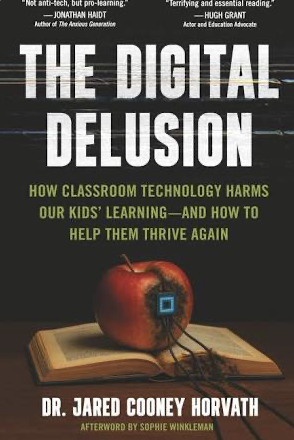
The Digital Delusion
What The Anxious Generation did for smartphones, The Digital Delusion is doing for EdTech. Researcher Jared Cooney Horvath examines the rise of EdTech around the world and its impacts, along with practical tips for advocacy and supporting our kids. Horvath also has a Substack of the same name.